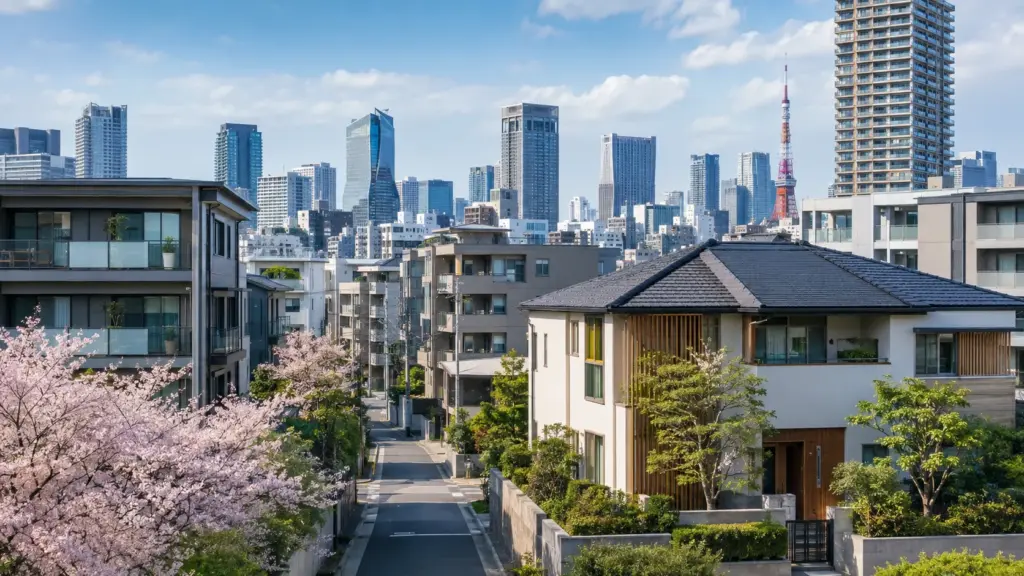
Can foreigners buy property in Japan? Can you get a Japanese mortgage without permanent residency? This 2026 Japan property buying guide covers eligibility, mortgages for Taiwan residents and other foreigners, the home-buying process, taxes and fees, condos vs. detached houses, and where to buy in Tokyo, Yokohama, Kawasaki, Osaka, Kyoto, Kobe, Fukuoka, Hokkaido, Karuizawa, Atami, Miyakojima, and Ishigaki. It also includes July 2026 REINS resale condo transaction prices and current vacation-home price examples.
Buying Property in Japan 2026|Can Foreigners Buy? Mortgages, Home Prices, Condos and Vacation Homes Explained
When people start thinking about buying property in Japan, the first question is usually:
“Can a foreigner actually buy a home in Japan?”
The second question is usually:
“Can I get a mortgage if I do not have Japanese permanent residency?”
The answers are more flexible than many people expect.
For ordinary residential real estate, Japan’s Ministry of Justice has procedures specifically covering foreign individuals who live outside Japan and become registered owners of Japanese property.
In other words, being a foreign national or living overseas does not automatically prevent you from becoming the registered owner of an ordinary condominium, house, or residential property in Japan.
What becomes much more complicated is financing.
Your mortgage options can change dramatically depending on:
Where you live
Your residence status in Japan
Whether you have permanent residency
Where your income comes from
Whether the property is for your own residence, a second home, or investment
The location and type of property
Here is a practical 2026 guide to buying property in Japan.
Can Foreigners Buy Property in Japan?
For ordinary residential property, generally yes.
Japan’s Ministry of Justice has specific procedures for registering ownership when a foreign individual or foreign corporation residing outside Japan becomes the registered owner of Japanese real estate.
Foreign buyers who cannot obtain a Japanese seal registration certificate can also use appropriate signature certification from a foreign notary or other qualifying authority, depending on the circumstances.
That means you should not assume that you cannot buy simply because you are not Japanese.
However, buying property and obtaining financing are two separate issues.
A bank may evaluate:
Residence
Visa or residence status
Employment history
Income
Assets
Credit profile
Age
Property location
Collateral value
Whether the property is for personal use or investment
This is why the statement “foreigners cannot get mortgages in Japan” is too broad.
If You Live Outside Japan, There May Be an Additional Reporting Requirement
This is particularly important for overseas buyers.
Japan’s Ministry of Finance currently states that certain non-residents acquiring Japanese real estate or rights relating to real estate may be required to make a post-transaction report under the Foreign Exchange and Foreign Trade Act, commonly referred to as FEFTA.
Where the requirement applies, the report is generally submitted to the Minister of Finance through the Bank of Japan.
The general deadline is within 20 days of the acquisition.
A representative living in Japan may also be able to submit the report on behalf of the buyer.
If you live in Taiwan or another country and are purchasing Japanese property as a non-resident, ask your judicial scrivener or real estate professional:
Does this transaction require FEFTA reporting?
Who will prepare the report?
What date counts as the acquisition date?
What documents are required?
Do not assume that completing the ownership transfer is automatically the end of the process.
A New Property Registration Rule From April 2026
Beginning April 1, 2026, Japan introduced mandatory registration requirements when the name or address of a registered property owner changes.
In principle, the change must be registered within two years.
This matters especially for owners living overseas because Japanese authorities cannot automatically obtain updates when a foreign resident moves from one overseas address to another.
For example, if you own a Japanese apartment while living in Taiwan and later move to the United States, you should also remember to update the registered address associated with your Japanese property.
Can Foreigners Get a Mortgage in Japan?
Yes, in some circumstances.
But the answer depends heavily on your personal status.
Situation 1: You Have Japanese Permanent Residency
This is generally the easiest category for accessing mainstream Japanese mortgage products.
Japan Housing Finance Agency’s FLAT35 program, for example, states that foreign applicants must generally hold either:
Permanent Resident status
or
Special Permanent Resident status
That does not mean permanent residents are automatically approved.
Banks still evaluate:
Income
Debt
Age
Credit
Property value
Repayment capacity
But permanent residency usually gives you access to a broader range of mortgage products.
Situation 2: You Live and Work in Japan but Do Not Have Permanent Residency
You may still have options.
Tokyo Star Bank currently offers Star Mortgage, a product specifically designed for foreign nationals living in Japan who do not have permanent residency.
The bank’s published conditions include requirements relating to:
Actual residence in Japan
Employment history in Japan
Income
Age
Japanese-language ability
Property eligibility
Bank underwriting
The loan may be used for qualifying new or resale condominiums and houses used as the applicant’s or family’s residence.
So:
“No permanent residency = no Japanese mortgage”
is not accurate.
PRESTIA Is Another Example
SMBC Trust Bank PRESTIA also states that permanent residency is not necessarily required for every foreign applicant.
Its general foreign-applicant criteria include residence in Japan, stable income, and other bank requirements.
Short-term visitors are generally outside the normal eligibility framework.
This is another example of why Japanese mortgage rules cannot be reduced to a simple permanent-residency yes-or-no question.
Can You Get a Japanese Property Loan While Living in Taiwan?
For some buyers, yes.
This is particularly important for Taiwanese readers.
Tokyo Star Bank currently offers a Star Real-Estate Investment Loan for Non-Residents of Japan that includes a program for eligible Taiwan residents.
The bank’s published conditions include requirements such as:
Holding a Republic of China (Taiwan) passport
Living in Taiwan
Being a Taiwan tax resident
Providing qualifying official income or asset documentation
Meeting age and underwriting requirements
Traveling to Tokyo Star Bank’s head office for the final contract process
The product may be used for qualifying investment properties and, in some cases, qualifying second homes or homes occupied by family members in Japan.
This means a person living in Taiwan does not necessarily have to pay 100% cash for a property in Tokyo, Osaka, or another eligible area.
However, this is a specific bank product.
It does not mean every Taiwan resident will qualify.
What Types of Properties Can Qualify?
Under Tokyo Star Bank’s current non-resident property loan framework, qualifying investment properties may include:
New condominium units
Resale condominium units
Entire apartment buildings
Certain commercial building units
Certain office units
New detached houses
Resale detached houses
For qualifying second-home or family-use cases, condominiums and houses may also be considered.
Every property is still subject to collateral valuation and underwriting.
A bank offering a product does not mean the particular home you want will automatically qualify.
Which Areas Are Currently Covered for Taiwan Residents?
Tokyo Star Bank currently lists qualifying areas including:
Tokyo’s 23 wards
Musashino City
Mitaka City
Chofu City
Koganei City
Kokubunji City
Kunitachi City
Tachikawa City
Yokohama City
Kawasaki City
Osaka City
Nagoya City
Kyoto City
Kobe City
Fukuoka City
Selected parts of Kumamoto Prefecture, including Kikuyo, Koshi, Ozu, and parts of Kumamoto City
Even within these cities, individual properties may be rejected by the bank.
This is why buyers who need financing should first find out where their lender is willing to lend.
Do not fall in love with a property first and start asking about financing afterward.
Can You Use the Same Taiwan-Resident Loan for Karuizawa, Atami or Okinawa?
Do not assume so.
The currently published coverage of Tokyo Star Bank’s Taiwan non-resident program does not list major vacation markets such as:
Karuizawa
Atami
Okinawa
Miyakojima
Ishigaki
That means you should not assume the same loan can be used for those areas.
If you specifically want a vacation home, confirm financing before seriously shopping.
Possible options may include:
Cash purchase
A different Japanese lender
Developer-affiliated financing
A lender willing to recognize overseas income
A loan secured against other assets
Financing can be one of the biggest differences between buying a Tokyo condominium and buying a vacation villa.
How Does the Japanese Home-Buying Process Work?
A typical purchase may look like this:
-
Decide whether the property is for your own residence, a second home, or investment.
-
Decide your city and total budget.
-
If you need financing, identify lenders that may accept your profile.
-
Find a real estate agent and begin viewing properties.
-
Submit a purchase application.
-
Complete mortgage pre-screening.
-
Receive the legally required Important Matters Explanation.
-
Sign the purchase agreement.
-
Pay the earnest-money deposit.
-
Complete the formal mortgage application.
-
Sign the loan agreement.
-
Complete loan funding and final payment.
-
Have a judicial scrivener complete ownership transfer and mortgage registration.
-
Receive the property and keys.
-
Confirm any FEFTA or other post-closing requirements.
For overseas buyers, having a good bilingual or internationally experienced agent and judicial scrivener can make the process much easier.
Should You Get Mortgage Pre-Approval Before Signing?
If you need financing, yes.
This is very important.
Once you sign a Japanese real estate purchase contract, an earnest-money deposit is usually involved.
If your mortgage is later rejected, whether you can cancel the contract and recover your deposit may depend on the mortgage contingency clause, known as a ローン特約.
The contract needs to clearly address:
Which lenders are covered
The loan amount
The application deadline
The cancellation deadline
What happens if financing is rejected
Do not rely only on a real estate agent saying:
“You should probably be approved.”
Get the bank involved before committing.
“Mansion” in Japan Does Not Mean a Luxury Mansion
One confusing Japanese real estate term is マンション, pronounced “mansion.”
In Japan, this generally means a condominium or apartment unit in a relatively substantial multifamily building, often reinforced concrete.
It does not mean a huge luxury detached mansion.
Meanwhile, アパート, or “apartment,” often refers to a smaller, lower-rise multifamily building.
If you want the type of condominium tower or managed residential building commonly found in major cities, the Japanese search term you will usually want is:
マンション
Who Should Buy a Japanese Condominium?
For a first overseas purchase, I would generally look at a managed urban condominium before a remote detached house.
The main reason is management.
With a condominium, shared areas such as:
Elevators
Exterior walls
Hallways
Common facilities
are typically handled by the building’s management association and management company.
However, owners normally pay:
Monthly management fees
and
Monthly repair reserve contributions
When buying a resale condominium, check:
Repair reserve balance
Major repair history
Management association finances
Outstanding unpaid fees
Building age
Earthquake standard
Distance to the station
Whether the land is freehold or leasehold
A beautifully renovated interior cannot compensate for a badly managed building.
Who Should Buy a Detached House?
A detached house, 一戸建て, offers advantages such as:
More space
Potential land ownership
Greater privacy
Possible garden
More control over the property
But the owner is also responsible for much more.
You may need to manage:
Roof repairs
Exterior walls
Garden maintenance
Drainage
Plumbing
Termites
Leaks
Equipment replacement
Vacant-home care
If you live overseas and only visit a few times a year, a detached home may require substantially more ongoing management than a condominium.
A low purchase price does not necessarily mean low ownership cost.
What Does “Vacation Home” Mean in Japan?
The Japanese term is usually:
別荘, or bessō.
It generally refers to a second home or vacation residence rather than a completely separate legal category of building.
A vacation property can be:
A detached house
or
A resort condominium
For an overseas owner, these two choices can feel completely different.
A detached villa offers more land, privacy, and freedom.
A resort condominium is usually easier to lock up and leave when you return overseas.
Where Is the Best Place to Buy Property in Japan?
There is no single best city.
The answer depends on what you want the property for.
1. Tokyo|Best for Big-City Convenience and Market Depth
If your budget allows it and you want:
Public transportation
Major employment centers
Urban convenience
A large resale market
Tokyo remains the most obvious place to research first.
However, Tokyo is no longer a “cheap Japanese property” market.
2026 resale condominium transaction data show a very large price gap between Tokyo and many other parts of Japan.
Buying Tokyo today is primarily about buying into:
Transportation
Employment
Urban convenience
Market depth
rather than simply buying inexpensive real estate.
2. Yokohama and Kawasaki|A Tokyo-Area Alternative
Kanagawa, particularly Yokohama and Kawasaki, is a natural alternative for buyers who want access to the Greater Tokyo area without necessarily paying Tokyo 23-ward prices.
These cities are also included in Tokyo Star Bank’s currently published Taiwan non-resident lending areas.
They may be worth comparing if you:
Need access to Tokyo
Want a larger home for the same budget
Have family in the Tokyo metropolitan region
Do not specifically need a Tokyo address
3. Osaka|One of the Best Big-City Price Balances
For a first Japanese property purchase, Osaka deserves serious consideration.
It is still one of Japan’s largest cities, but resale condominium prices remain considerably below Tokyo averages.
If your goal is:
Urban lifestyle
Second-home use
Long-term ownership
Potential rental demand
Osaka can offer a more approachable entry price than central Tokyo.
4. Fukuoka|Lower Entry Cost With Compact City Living
Fukuoka is another city I would consider early.
The city is relatively compact, and buyers should focus strongly on access to:
Hakata
Tenjin
Subway stations
Major employment and commercial areas
rather than simply looking for the cheapest price per square meter.
For overseas buyers, location within the city can matter much more than saving a little on the purchase price.
5. Kyoto|Buy Because You Love Kyoto, Not Just Because Tourists Visit
Kyoto can be attractive as a second-home location.
However, if the goal is investment, do not assume that high tourism automatically means any property will be easy to rent profitably.
You still need to evaluate:
Residential rental demand
Station access
Building rules
Permitted use
Local regulations
Realistic long-term rent
A property that works as a normal residence is very different from a property purchased with short-term tourist accommodation in mind.
6. Kobe|A Kansai Alternative to Osaka
If your lifestyle, work, or family connections are in Kansai, Kobe can also be worth comparing.
Tokyo Star Bank’s Taiwan non-resident property loan currently lists Kobe among its eligible general areas.
It may be especially attractive to buyers who prefer Kobe’s environment but still want access to the larger Kansai region.
7. Hokkaido|Lower Prices, but Climate Matters
Hokkaido resale condominium transaction prices remain well below Tokyo, Osaka, and Fukuoka averages.
However, detached homes and vacation homes require additional consideration because of:
Snow
Snow removal
Cold temperatures
Heating systems
Frozen plumbing risk
Winter vacancy management
For an overseas buyer who only visits occasionally, a managed urban condominium can be easier than a standalone house.
Where Should You Buy a Japanese Vacation Home?
8. Karuizawa|The Classic Tokyo-Area Vacation Home Market
If you imagine a traditional Japanese vacation villa, Karuizawa is one of the first places to research.
Current listings still include resale detached homes in the ¥30-million range, although prices vary enormously depending on:
Age
Land size
Location
Station access
Renovation condition
Management area
When buying an older Karuizawa villa, do not focus only on the sale price.
Check:
Insulation
Roof condition
Humidity
Winter conditions
Road access
Snow
Water and sewer systems
Private roads
Forest and garden maintenance
Renovation requirements
A ¥30-million home can become much more expensive after major renovation.
9. Atami|Ocean Views, Hot Springs and Easier Access From Tokyo
Atami is another market that often attracts overseas buyers.
Many resale houses are listed there, with a very wide price range.
Some older homes are so inexpensive that buyers may wonder:
“How can a Japanese vacation house cost only a few million yen?”
The answer is that the price may reflect:
Age
Steep terrain
Road access
Retaining walls
Parking limitations
Salt-air corrosion
Leaks
Hot spring rights
Hot spring fees
Management charges
Renovation needs
A beautiful ocean view and easy daily living are not always the same thing.
10. Miyakojima|For a New Resort Condominium
If you want an island lifestyle but do not want to maintain a standalone home, a resort condominium in Miyakojima may make more sense.
Current resort developments include new 2LDK and 3LDK condominium units.
For an overseas owner, condominium management can be a major advantage.
However, you still need to budget for:
Management fees
Repair reserve contributions
Typhoon exposure
Salt-air corrosion
Air travel costs
How often you will actually stay there
11. Ishigaki|Another Resort Condominium Option
Ishigaki also has resort-style condominium developments.
These properties can be useful to compare directly with detached vacation homes.
A detached home gives you greater independence.
A condominium gives you a management system for shared areas while you are outside Japan.
For an overseas owner, that difference can be extremely important.
If You Live in Taiwan, Should You Buy a Condo or a Vacation Villa?
For a first purchase, I would generally lean toward:
A managed urban condominium.
Especially in:
Tokyo
Yokohama
Kawasaki
Osaka
Fukuoka
The reason is not that these properties are guaranteed to appreciate.
It is because they are easier to understand and manage.
You have:
Comparable sales data
Clearly defined lending areas
Transportation information
Management associations
Rental-market data
Established urban infrastructure
A vacation home makes more sense once you are genuinely certain:
“I will return to this exact area every year.”
If the Goal Is Investment, What Should You Look At First?
Do not start with:
“How cheap is the property?”
Start with:
Distance from the station
Who the likely tenant is
Actual long-term rental demand
Building age
Building management
Repair reserve fund
Monthly ownership costs
Resale liquidity
Bank collateral valuation
Who will buy the property from you later
Japan has many very inexpensive properties in regional areas.
Sometimes they are inexpensive precisely because finding the next buyer is difficult.
For a first overseas real estate purchase, a normal property in a strong location can be safer to understand than a spectacular but isolated old villa.
10 Questions to Ask Before Buying a Resale Condominium
-
Is the land freehold or leasehold?
-
How old is the building?
-
Which earthquake-resistance standard applies?
-
What is the monthly management fee?
-
What is the monthly repair reserve contribution?
-
How much money is currently in the repair reserve fund?
-
When was the last major renovation?
-
When is the next major renovation scheduled?
-
Are there restrictions on leasing, short-term rentals, pets, or renovations?
-
Does the previous owner owe any management or repair-reserve fees?
The repair reserve is particularly important.
A building with very low monthly contributions is not automatically a good deal.
If the association has not saved enough, owners may later face higher monthly fees or extraordinary special assessments.
What Should You Check When Buying an Older Japanese Vacation House?
You need to inspect both the building and the land.
Important items include:
Road access
Private road rights
Parking
Slope stability
Retaining walls
Storm drainage
Termites
Roof
Exterior walls
Plumbing
Septic or sewer systems
Well water
Winter pipe protection
Hot spring rights
Resort management fees
A low listing price does not guarantee a low total cost.
What Other Costs Come With Buying Property in Japan?
In addition to the purchase price, buyers may encounter:
Real estate brokerage commission
Judicial scrivener fees
Ownership registration costs
Mortgage registration costs
Registration and license tax
Real estate acquisition tax
Stamp duty
Fixed asset tax
City planning tax
Fire insurance
Earthquake insurance
Mortgage fees
Management fees
Repair reserve contributions
Vacation homes may also have:
Resort management fees
Hot spring fees
Garden maintenance
Vacant-home inspection costs
When viewing properties, ask your agent:
“Besides the purchase price, how much cash will I need in total before closing?”
Do not budget only for the advertised property price.
The Most Important Takeaways for Buying Property in Japan in 2026
First, being a foreign national does not automatically prevent you from becoming the registered owner of ordinary Japanese residential property.
Second, not having permanent residency does not automatically mean you cannot obtain financing. Certain banks currently offer mortgage products to qualifying foreign residents without permanent residency.
Third, eligible Taiwan residents living in Taiwan may also have access to specific Japanese non-resident property loan programs, although the requirements are substantially stricter than normal domestic mortgages.
Fourth, for a first overseas purchase, a managed city condominium is often easier to manage than a remote old vacation house.
Fifth, do not be distracted by headlines about Japanese villas selling for only a few million yen. Renovation, access, management, taxes, vacancy, and eventual resale can matter more than the initial purchase price.
FAQ
Can Taiwanese Citizens Buy Property in Japan?
For ordinary residential real estate, foreign buyers can generally become registered property owners in Japan.
The exact documentation required depends on the buyer’s residence, nationality, and registration circumstances.
Can I Get a Japanese Mortgage Without Permanent Residency?
Potentially, yes.
Tokyo Star Bank currently offers Star Mortgage for qualifying foreign residents in Japan who do not have permanent residency.
PRESTIA also has mortgage eligibility pathways that do not universally require permanent residency, subject to its own income, residence, employment, and underwriting requirements.
Can I Get a Japanese Property Loan While Living in Taiwan?
Some eligible buyers can.
Tokyo Star Bank currently offers a non-resident Japanese real estate loan program that includes qualifying Taiwan passport holders who live and pay taxes in Taiwan and satisfy its financial and underwriting criteria.
Can a Taiwan Resident Use That Loan to Buy a Karuizawa Villa?
Do not assume so.
Karuizawa is not currently included in the principal location list published for Tokyo Star Bank’s Taiwan non-resident property-loan program.
You would need to investigate alternative financing or cash purchase options.
Is a Condominium or Detached House Better in Japan?
For an overseas first-time buyer, a managed city condominium is usually easier to manage.
A detached house may be better for someone planning to live there for long periods and who values land, privacy, and space.
For vacation use, buyers should also compare detached villas with managed resort condominiums.
Where Is the Best Place to Buy Property in Japan?
For major-city convenience: Tokyo.
For Tokyo-area access at a potentially lower entry price: Yokohama or Kawasaki.
For a balance of large-city living and lower purchase prices: Osaka.
For compact urban living: Fukuoka.
For a classic vacation villa: Karuizawa.
For an ocean-view and hot-spring second home: Atami.
For an island resort condominium: Miyakojima or Ishigaki.
These are lifestyle and market-positioning suggestions, not guarantees of investment returns or future appreciation.
Conclusion|Decide Why You Are Buying Before Deciding Where to Buy
One of the easiest mistakes to make when buying property in Japan is not necessarily paying too much.
It is buying before you fully understand why you want the property.
If you plan to live there full-time, prioritize:
Transportation
Hospitals
Supermarkets
Work commute
Daily convenience
If you live overseas and will only visit occasionally, management should become one of your highest priorities.
If you want a second home, ask yourself how many weeks per year you will realistically use it.
If you want an investment property, calculate:
Rent
Vacancy
Management
Taxes
Repairs
Financing
Future resale demand
A Tokyo condominium, an Osaka apartment, a Fukuoka home, a Karuizawa villa, and an Atami vacation house are fundamentally different products.
Define your purpose first.
Choose the property type second.
Then compare prices.
That approach is usually safer than starting with the question:
“Where in Japan can I buy the cheapest house?”
Sources: Japan Ministry of Finance, Japan Ministry of Justice, Japan Housing Finance Agency / FLAT35, Tokyo Star Bank, SMBC Trust Bank PRESTIA, REINS, SUUMO, Tokyu Resort, based on publicly available information current as of August 2026.
Image Sources: Official Japanese government websites, REINS, official bank websites, and official property-platform or development materials.
Disclaimer: This article is based on publicly available information as of August 2026 and is intended for general informational purposes only. It does not constitute legal, tax, mortgage, immigration, or investment advice. Foreign-buyer rules, non-resident reporting requirements, mortgage eligibility, taxation, registration procedures, and lending terms vary depending on nationality, country of residence, tax residency, immigration status, income, assets, intended use, property location, and lender underwriting. Before signing a purchase contract, confirm current requirements with a licensed Japanese real estate professional, bank, judicial scrivener, and, where necessary, a qualified Japanese tax professional.
2026 Japan Home Prices, Mortgage Requirements and Vacation-Home Price Guide
All monetary information is consolidated in this final section.
The REINS figures below represent July 2026 completed resale condominium transactions.
They are not new-construction condominium prices, listing prices, or fixed market prices for every property in each region.
| Region | July 2026 Average Resale Condo Transaction Price | Average Size | Average Building Age |
|---|---|---|---|
| Tokyo | Approx. ¥70.04 million | 57.84㎡ | 26.29 years |
| Kanagawa | Approx. ¥38.92 million | 66.02㎡ | 28.62 years |
| Kyoto | Approx. ¥38.25 million | 62.27㎡ | 27.08 years |
| Osaka | Approx. ¥34.89 million | 66.03㎡ | 28.32 years |
| Fukuoka | Approx. ¥31.26 million | 67.41㎡ | 26.16 years |
| Hokkaido | Approx. ¥23.07 million | 74.00㎡ | 31.08 years |
These figures show how significant the current price difference can be between Tokyo and other major Japanese markets.
Tokyo Star Bank Star Mortgage Requirements for Foreign Residents Without Permanent Residency
Tokyo Star Bank’s currently published Star Mortgage framework includes general requirements such as:
Qualifying salaried employees generally need at least one year of continuous employment in Japan.
Annual income is generally expected to be at least ¥4 million.
Certain salaried employees age 40 or younger may qualify from approximately ¥3 million annual income if additional collateral and underwriting conditions are satisfied.
Loan amount: approximately ¥5 million to ¥100 million.
Maximum loan term: up to 35 years.
Final approval remains subject to bank underwriting.
PRESTIA Foreign Applicant Income Reference
SMBC Trust Bank PRESTIA currently publishes foreign-applicant criteria that generally include:
Residence in Japan
Exclusion of short-term visitors
Stable income
Prior-year annual income generally above ¥10 million
Its Housing Loan can offer substantial lending limits depending on the borrower and property, but all loan amounts remain subject to underwriting.
Tokyo Star Bank Loan for Eligible Taiwan Residents
For its Star Real-Estate Investment Loan for Non-Residents of Japan, the Taiwan program currently includes a financial threshold based on either:
Prior-year official annual income equivalent to at least ¥10 million
or
Net assets equivalent to at least ¥30 million
Maximum term: up to 25 years.
Loan amounts currently begin from approximately ¥20 million.
Actual financing remains subject to borrower income, assets, collateral valuation, property type, location, and final bank approval.
Typical Earnest-Money Deposit
Japanese home-buying guidance commonly indicates that earnest money at the signing of the purchase agreement is often around:
5%–10% of the purchase price.
The actual amount is negotiated in each transaction.
Karuizawa Vacation-Home Price Reference
As of August 2026, Karuizawa resale detached-home listings still include properties in the ¥30-million range.
This means buyers can still find older Karuizawa vacation homes around ¥30 million and above, but age, land size, location, renovation condition, utilities, and management requirements vary dramatically.
These are listing prices, not average completed transaction prices.
Atami Vacation-Home Price Examples
Atami has an even wider price range.
Current resale listings include individual older houses at prices such as approximately:
¥2.3 million for an older 1970s house in Ainohara
¥9.8 million for an older home in Shimotaga
¥11.5 million for an older property in Izusan
These are individual listing examples rather than market averages.
Low purchase prices may reflect significant age, access limitations, renovation requirements, resort-management costs, or other property-specific issues.
Miyakojima New Resort Condominium Prices
Current new condominium development pricing for Clare M Dia Miyakojima is approximately:
2LDK units from around 55.50㎡
3LDK units around 70.95㎡
Published prices: approximately ¥41.8 million to ¥67 million.
Ishigaki Resort Condominium Prices
For Coral Bay Ishigakijima 6, current published information includes:
3LDK units
Approximately 69.09–73.25㎡
Published prices of approximately ¥41.9 million to ¥55.6 million
Monthly management fees of approximately ¥14,100–¥14,900
Monthly repair reserve contributions of approximately ¥5,400–¥5,700
A one-time initial repair reserve contribution of approximately ¥401,000–¥425,000
All property prices, lending requirements, fees, and availability can change. Buyers should rely on current bank underwriting, the latest REINS transaction data, the seller’s official price, and the final purchase contract before making a decision.