
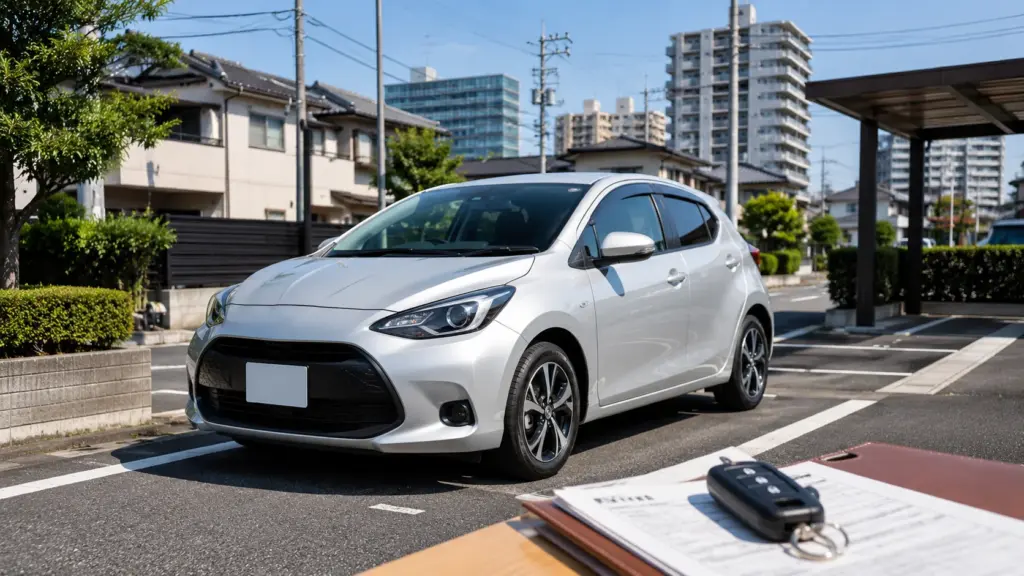
Can foreigners buy a car in Japan? Can you get a Japanese auto loan without permanent residency? This 2026 guide explains how to buy a new or used car in Japan, foreigner-friendly car loans, parking certificates, shaken inspections, compulsory insurance, vehicle taxes, kei cars, and current prices for the Suzuki Alto, Honda N-BOX and Toyota Prius.
2026 Guide to Buying a Car in Japan|Can Foreigners Buy or Finance a Car? New & Used Car Prices, Parking Certificate, Shaken and Costs
If you are planning to live in Japan—especially outside central Tokyo or Osaka—there is a good chance you will eventually ask the same question:
Should I buy a car in Japan?
And for foreign residents, that usually leads to several more questions:
Can foreigners legally own a car in Japan?
Can you finance a car without permanent residency?
How much does a new or used car cost?
And what other expenses come after the purchase?
The short answer is:
Yes, foreigners can buy and own cars in Japan.
Japanese nationality itself is not a requirement for vehicle ownership.
And not having Japanese permanent residency does not automatically mean that you cannot obtain financing.
What matters much more is whether you have the documents required for registration, a usable address in Japan, an appropriate residence status, stable income, a legal parking space, and whether the bank or finance company accepts your individual situation.
Japan’s Ministry of Land, Infrastructure, Transport and Tourism even provides procedures for foreign nationals who cannot submit a Japanese seal registration certificate, allowing certain signature certificates issued by embassies, consulates or government authorities to be used in relevant vehicle registration procedures.
So the statement that “foreigners cannot buy cars in Japan” is simply not accurate.
Buying a Car in Japan: Quick Answers
| Question | Answer |
|---|---|
| Can foreigners buy a car in Japan? | Yes |
| Can foreigners get a car loan? | Possibly, depending on the lender and applicant |
| Do all banks lend to foreigners without PR? | No |
| Can a work visa holder apply for financing? | Some lenders allow it |
| Do regular cars generally require a parking certificate? | Yes, depending on location and registration rules |
| Do kei cars require a parking certificate? | Different system; a parking notification may be required in designated areas |
| When is the first shaken inspection for a new private passenger car? | Usually after 3 years |
| How often after that? | Usually every 2 years |
| Is compulsory automobile liability insurance required? | Yes |
| Is voluntary insurance required by law? | No, but it is highly recommended |
| Is the environmental performance levy still charged? | It was abolished from April 2026 |
Can a Foreigner Really Buy a Car in Japan?
Yes.
Japanese vehicle registration rules do not state that only Japanese citizens can own a vehicle.
For example, Japan’s Ministry of Land, Infrastructure, Transport and Tourism specifically provides documentation procedures for foreign nationals who cannot submit a Japanese seal registration certificate.
Depending on the registration procedure, a signature certificate or similar document issued by an embassy, consulate or authorized government authority showing the person’s name and address may be accepted.
The practical question is therefore not:
“Are you Japanese?”
It is:
“Can you provide the documents required to register the vehicle?”
Can a Tourist Buy a Car in Japan?
This is where things become more complicated.
There is an important difference between:
Buying a physical vehicle
and
Registering, insuring and legally keeping that vehicle in Japan.
A foreign nationality does not automatically prevent ownership.
However, long-term vehicle ownership normally involves:
A usable address in Japan
Vehicle registration documents
A designated base of use
A legal parking space
Compulsory insurance
Tax procedures
License plate registration
For someone visiting Japan only as a short-term tourist, completing this entire process in their own name can therefore be much more difficult than it is for a resident.
For someone already living in Japan with:
A work visa
A student residence status
Long-term residency
A fixed Japanese address
the process is much more realistic.
Financing is a separate issue and depends on the lender.
Being legally able to register a car does not automatically mean that a bank will approve your loan.
The Basic Process of Buying a Car in Japan
A simple version of the process looks like this:
Choose a car
↓
Confirm a parking space
↓
Complete the parking certificate or parking notification procedure
↓
Choose cash or financing
↓
Prepare registration documents
↓
Arrange compulsory insurance and other insurance
↓
Complete registration and obtain plates
↓
Take delivery
If you buy from a major new-car dealer or used-car dealer, the dealer can usually handle many of the registration procedures for you.
However, you will still need to provide the required personal documents, loan documents and parking information.
Step 1: New Car or Used Car?
Japan has several major categories:
New cars
Used cars
Nearly new or unused registered vehicles
A new car can make sense if you are planning to stay in Japan long term.
Advantages may include:
Simpler vehicle history
Manufacturer warranty
More finance options
A longer period before the first shaken inspection
Used cars, on the other hand, can offer much lower entry prices.
But there is one Japanese used-car pricing term you absolutely need to understand:
車両価格
Vehicle Price
and
支払総額
Total Payment Price
These are not the same thing.
Do Not Look Only at the Vehicle Price
“Vehicle Price” usually refers to the price of the car itself.
“Total Payment Price” is closer to what you actually need to pay to purchase the car, including applicable purchase-related fees.
Official used-car networks such as Honda U-Select clearly separate:
Vehicle price
Additional fees
Total payment price
That means you should not shop for a used car in Japan by looking only for:
“¥500,000 car”
Instead, always ask:
“What is the 支払総額?”
That figure is usually much more useful when comparing actual purchase costs.
Step 2: Find Parking Before Buying a Regular Car
This is one of the biggest surprises for many people buying their first car in Japan.
Japan has strict rules concerning where a car is normally stored.
For many regular passenger cars, the parking place must satisfy several conditions.
In general:
It cannot be a public road.
It should normally be within 2 kilometers of the vehicle’s registered “base of use.”
The vehicle must be able to enter and exit the space.
The parking space must physically fit the vehicle.
You must have the legal right to use the space.
That means the Japanese buying process often works better in this order:
Find parking first.
Then buy the car.
What Is a Japanese Parking Certificate?
The Japanese term most people hear is:
車庫証明
Shako Shomei
This refers to the vehicle parking-place certification system.
For many regular cars, you need to prove that there is a legal place where the vehicle will normally be kept.
If the parking area is on property you own, you use the applicable ownership-related documents.
If you rent a monthly parking space—月極駐車場—you normally need documentation showing that you are authorized to use it.
The parking space is generally required to be within 2 kilometers of the vehicle’s base of use.
Do Kei Cars Need a Parking Certificate?
Kei cars are treated differently from regular cars.
They do not always follow exactly the same parking certificate process.
However, this does not mean:
“A kei car never needs parking paperwork.”
In certain designated municipalities or urban areas, a kei car owner may still need to submit a parking-place notification.
So before buying a kei car, confirm the specific rules with the police authority responsible for your address.
Living in Tokyo? Check Parking Prices Before Car Prices
If you live in central Tokyo or another dense Japanese city, the first search I would do is not:
Toyota
Honda
or Suzuki.
I would search:
月極駐車場
Monthly parking.
A car is purchased once.
Parking is paid every month.
And for many regular vehicles, parking is directly connected to the legal registration process.
For urban residents, the cost and availability of parking can matter more than the difference between two car models.
Can Foreigners Finance a Car in Japan?
Yes.
But this does not mean:
“Every foreigner can borrow from every Japanese bank.”
Loan requirements vary significantly between lenders.
This is one of the most important things to understand before applying.
Permanent Residents Usually Have More Bank Loan Options
Take Mitsubishi UFJ Bank’s My Car Loan as an example.
Its published eligibility rules for foreign nationals require applicants to have permanent resident status in Japan, to live in Japan, and to meet the bank’s language and other application requirements.
That means someone without permanent residence should not assume that every major Japanese bank’s standard auto loan is available to them.
You need to check each bank individually.
No Permanent Residency? Financing May Still Be Possible
This is important.
Not having permanent residence does not automatically mean that you must pay cash.
Suruga Bank offers an auto-loan product specifically aimed at foreign residents.
Its published criteria indicate that foreign nationals with a residence status allowing employment and stable income may apply even if they do not have Japanese permanent residency.
Approval is still subject to underwriting.
Applying does not guarantee approval.
But it means a foreign worker in Japan with:
A valid work-eligible residence status
Stable employment
Regular income
A Japanese residence
may still have formal financing options.
What Can a Foreigner-Friendly Auto Loan Be Used For?
Depending on the lender and product, permitted uses can include things such as:
Buying a used car
Buying a motorcycle
Driving license expenses
Vehicle repairs
Shaken costs
Automotive equipment
However, restrictions may apply.
For example, some loans may exclude:
Business-use vehicle purchases
Private-party vehicle transactions
So if you want to buy directly from an individual seller, check the loan conditions before agreeing to the purchase.
Dealers Also Offer Vehicle Financing
Banks are not the only option.
Japanese automakers and dealers also offer financing.
Examples include:
Honda Finance
Suzuki Finance
Dealer credit plans
Residual value credit plans
Honda offers a residual-value type of finance.
Suzuki offers a similar structure through its:
かえるプラン
Kaeru Plan
The basic idea is that the lender estimates part of the car’s future value in advance.
You then finance the remaining portion over the contract period.
Why Do Some Japanese Car Ads Show Extremely Low Monthly Payments?
Often because they are using:
残価設定型クレジット
Residual Value Credit.
Also commonly called:
残クレ
Instead of dividing the entire vehicle cost evenly over the loan term, part of the expected future vehicle value is left for the final payment.
This makes the monthly payments look lower.
At the end of the contract, depending on the plan, you may be able to:
Return the vehicle
Trade it for another vehicle
Pay the final balance and keep it
Never Judge a Loan by the Monthly Payment Alone
If a salesperson says:
“It is only ¥15,000 a month.”
do not stop there.
Ask for:
Down payment
Loan term
Effective interest rate
Bonus-month payments
Final balloon payment
Total amount paid
Mileage limits
Return-condition requirements
Only after looking at all of these can you compare the real cost.
With residual-value financing, returning the vehicle may also be subject to mileage and condition rules.
If the car does not meet those requirements, extra charges may apply.
What Does It Cost to Own a Car in Japan?
The purchase price is only the beginning.
Typical ongoing expenses include:
Parking
Automobile tax
Kei car tax
Automobile weight tax
Shaken
Compulsory automobile liability insurance
Voluntary auto insurance
Gasoline or charging
Expressway tolls
Tires
Maintenance
Repairs
This is why:
“Can I afford to buy this car?”
and
“Can I afford to own this car for five years?”
are two different questions.
Japan Automobile Tax
Regular private passenger vehicles are subject to annual automobile tax.
The amount generally depends on engine displacement and registration category.
For newer private passenger cars, standard annual rates are divided into engine-size bands such as:
Up to 1.0L
Over 1.0L to 1.5L
Over 1.5L to 2.0L
Over 2.0L to 2.5L
and higher categories.
This is one reason smaller-engine vehicles can be attractive in Japan.
Why Are Kei Cars So Popular?
Kei cars are popular for several reasons.
They are:
Small
Easy to park
Practical in narrow streets
Usually cheaper than larger cars
Subject to lower annual vehicle tax than many regular passenger cars
For a standard privately owned four-wheel kei passenger vehicle in the applicable newer-registration category, the annual kei vehicle tax is relatively low.
That makes kei cars particularly appealing for:
Commuting
School runs
Shopping
Local travel
Suburban daily life
How Often Is Shaken Required?
Shaken is Japan’s periodic vehicle inspection system.
For a new privately owned passenger car, the first inspection is normally due:
3 years after initial registration.
After that, it is generally:
Every 2 years.
This is one of the benefits of buying a brand-new car.
For a used car, always check:
How much shaken validity is remaining?
A cheap used car with shaken about to expire may create an additional near-term expense.
Shaken Is More Than Just an Inspection Fee
When people in Japan say:
“Shaken is expensive,”
they are usually not referring only to the inspection itself.
Costs around shaken may include:
Inspection or dealer service fees
Automobile weight tax
Compulsory insurance
Maintenance
Replacement of worn parts
Repairs
That is why the remaining shaken period matters when comparing used cars.
Compulsory Automobile Liability Insurance Is Mandatory
Japan’s compulsory automobile liability insurance is called:
自賠責保険
Jibaiseki Hoken
Applicable vehicles must carry this insurance in order to be legally driven on public roads.
Its main purpose is to provide basic compensation for bodily injury caused to others in a traffic accident.
But it should not be confused with comprehensive car insurance.
Voluntary Auto Insurance Is Still Very Important
Japan’s optional auto insurance is known as:
任意保険
Policies can provide additional protection for areas such as:
Third-party liability
Damage to another vehicle
Damage to your own vehicle
Driver and passenger injury
Roadside assistance
Traffic accident liability can far exceed the protection offered by compulsory insurance.
So although voluntary insurance is not the same legal requirement as Jibaiseki, it is an important part of responsible car ownership.
Important 2026 Tax Change: Environmental Performance Levy Abolished
One major change for 2026 is that Japan abolished:
自動車税環境性能割
and
軽自動車税環境性能割
from April 2026.
These were acquisition-stage taxes based on environmental performance.
However, this does not mean:
“Japan no longer has car taxes.”
Other taxes and fees still remain, including:
Annual automobile tax
Kei car tax
Automobile weight tax
and other vehicle-related costs.
What Kind of Car Is Good for a First-Time Buyer in Japan?
It helps to divide buyers into three broad groups.
1|One or Two People, Mainly Local Transportation
Consider:
Suzuki Alto
It is a small kei car.
It is easy to park and designed for basic daily transportation.
If you live in a suburban area and mainly drive to:
Work
The train station
The supermarket
Local appointments
a small kei car can be very practical.
2|Small Family and More Interior Space
Consider:
Honda N-BOX
The N-BOX is one of Japan’s best-known tall kei cars.
Although its exterior footprint is compact, its interior design emphasizes usable space.
It can be especially useful if you often:
Carry children
Transport groceries
Pick up family members
Need more vertical cabin space
3|Long-Distance Driving and Expressways
Consider:
Toyota Prius
The Prius is a regular passenger vehicle rather than a kei car.
Its hybrid powertrain makes it a common choice for drivers who want a more conventional passenger-car experience for:
Long commutes
Expressway driving
Family travel
Long-distance trips
Is a Used Car Always Cheaper Than a New One?
Not necessarily.
Popular kei cars have strong resale values in Japan.
A recent-model, low-mileage Honda N-BOX may not be dramatically cheaper than a new one.
This is especially true for nearly new used vehicles.
So when comparing new and used cars, look at:
New-car total purchase price
Used-car total payment price
Remaining shaken
Mileage
Warranty
Tire condition
Maintenance history
Do not look at model year alone.
Used Prius Prices Can Vary Dramatically
The Prius has been sold in Japan for many generations.
The used market therefore includes:
Older generations
Previous-generation models
Current-generation models
Hybrid versions
PHEV versions
Different grades
Prices can differ enormously.
When searching for a used Prius, first define:
Generation
Model year
Mileage
Grade such as G or Z
Then compare similar vehicles.
A market-wide “average Prius price” is not very useful if it mixes 10-year-old cars with nearly new current-generation models.
First-Time Used-Car Buyer? Consider Certified Used Cars
If you are new to Japan and not confident evaluating a used vehicle, you may want to begin with manufacturer-backed used-car networks such as:
Honda U-Select
Toyota Certified Used Cars
Suzuki official used-car listings
These typically make it easier to review information such as:
Mileage
Model year
Accident repair history
Warranty
Shaken status
Vehicle price
Fees
Total payment price
Once you understand the market, you can compare these prices with independent used-car dealers.
If You Do Not Have Permanent Residency, Here Is a Practical Buying Strategy
If you are working in Japan but do not yet have PR:
Step 1:
Choose your budget and vehicle type.
Step 2:
Ask the dealer whether its financing program accepts your residence status.
Step 3:
Compare lenders that explicitly accept eligible non-permanent-resident foreign applicants.
Step 4:
Compare total repayment cost—not just monthly payment.
Step 5:
If financing becomes too expensive, consider buying a lower-priced used kei car with cash.
This can sometimes be more sensible than accepting expensive financing just to obtain a newer car.
If You Have Permanent Residency
Permanent residency generally gives you access to a broader range of financing options.
You may be able to compare:
Bank My Car Loans
Manufacturer finance
Dealer loans
Used-car financing
Residual-value credit
A major-bank auto loan is not automatically the best option.
Dealer financing is not automatically the worst.
Compare the full contract.
6 Common Mistakes When Buying a Car in Japan
Mistake 1
Looking at the car price but ignoring monthly parking.
Mistake 2
Looking only at 車両価格 instead of 支払総額.
Mistake 3
Choosing residual-value credit because the monthly payment looks low.
Mistake 4
Applying for a loan without first checking whether your residence status is eligible.
Mistake 5
Buying a used car without checking the shaken expiration date.
Mistake 6
Assuming compulsory insurance alone is enough protection.
Avoiding these mistakes makes buying a car in Japan much easier.
Japan Car-Buying Checklist
Before buying, confirm:
□ Japanese address and registration documents
□ Residence status
□ Parking space
□ Parking certificate or notification requirements
□ New or used car
□ Vehicle price
□ Total payment price
□ Down payment
□ Loan interest rate
□ Final balloon payment
□ Shaken expiration
□ Compulsory insurance
□ Voluntary insurance
□ Automobile or kei vehicle tax
□ Automobile weight tax
□ Maintenance costs
□ Expressway usage
□ Monthly parking cost
If you can answer all of these, you are much closer to knowing what the car will really cost.
Conclusion: Buying a Car in Japan as a Foreigner Is Possible—Owning It Is What You Need to Budget For
In 2026, foreign nationality itself is not the main obstacle to buying a car in Japan.
If you have permanent residency, you may have access to a wider range of bank and dealer financing.
If you do not have permanent residency but hold an eligible work residence status and have stable income, some lenders still accept applications from foreign residents.
The more important questions are:
Where do you live?
How much is parking?
How many kilometers will you drive each year?
Will you regularly use expressways?
How many years do you plan to keep the car?
For simple suburban transportation, a kei car may make excellent sense.
For a small family, a tall kei car such as the N-BOX offers more usable space.
For frequent long-distance and expressway driving, a regular hybrid such as the Prius may make more sense.
So before asking:
“Cars in Japan seem cheap—should I buy one?”
ask:
“What will this car cost me every year after I buy it?”
That is the number that matters most.
Image Source:Toyota, Honda, Suzuki official websites / Japanese government public information.
Sources:Japan Ministry of Land, Infrastructure, Transport and Tourism, National Police Agency, Ministry of Finance, Mitsubishi UFJ Bank, Suruga Bank, Honda, Honda U-Select, Toyota, Toyota Certified Used Cars, Suzuki and Suzuki Finance.
Disclaimer:
This article is based on Japanese government, financial institution and automaker information available as of August 2026 and is intended for general informational purposes. Vehicle registration rules, parking certificate procedures, taxes, financing eligibility, interest rates, insurance, vehicle prices and used-car inventory may vary depending on location, residence status, credit profile, vehicle and date. Loan approval is determined individually by each financial institution. Always confirm current requirements with the relevant Japanese authority, police department, lender, insurer and dealership before purchasing a vehicle.
FAQ
Can foreigners buy a car in Japan?
Yes. Foreign nationality itself does not prevent a person from owning a vehicle in Japan, provided the required registration documentation can be submitted.
Can I finance a car in Japan without permanent residency?
Possibly. Not every lender accepts non-permanent residents, but some lenders offer products for eligible foreign residents with work-authorized residence status and stable income.
Is it easier to finance a car if I have Japanese permanent residency?
Generally, yes. Permanent residents may qualify for a wider range of standard bank auto loans.
Do I need a parking space before buying a car in Japan?
For regular vehicles, a legal parking place is generally required for the parking certificate process. The parking place normally must be within 2 kilometers of the vehicle’s base of use.
Do kei cars need a parking certificate?
The process is different from regular vehicles. In certain designated areas, kei car owners may still be required to submit a parking-place notification.
How often is shaken required?
For a new private passenger vehicle, the first shaken is normally after three years. After that, it is generally every two years.
Is compulsory insurance required?
Yes. Vehicles subject to Japan’s compulsory automobile liability insurance system must carry valid coverage in order to be legally driven.
What price should I look at when buying a used car in Japan?
Look at the 支払総額, or total payment price, not only the 車両価格, or vehicle price.
2026 Japan Car Prices, Taxes and Ownership Costs
All prices are placed at the end of this article for easier comparison.
Suzuki Alto HYBRID S
Category:
Kei car
Current manufacturer suggested retail price example:
Suzuki Alto HYBRID S 2WD
From approximately ¥1,350,800
Different drivetrains, colors and optional equipment may increase the price.
Insurance, registration-related fees, recycling charges and other purchase costs may be charged separately.
Honda N-BOX
Category:
Tall kei car
Honda N-BOX standard model:
FF
From ¥1,768,800
4WD, Custom, JOY and higher grades cost more.
Insurance, taxes, registration-related expenses, options and recycling fees may be additional.
Toyota Prius
Category:
Regular hybrid passenger car
Current Toyota example:
Prius G Hybrid 2WD
Approximately ¥3,324,200
Other hybrid, PHEV and higher-grade versions are priced differently.
Honda N-BOX Used-Car Example
A recent Honda U-Select example:
2024 Honda N-BOX Base Grade
Mileage:
Approximately 11,000 km
Vehicle price:
Approximately ¥1,400,000
Additional fees:
Approximately ¥71,000
Total payment price:
Approximately ¥1,471,000
Used-car prices and inventory change frequently.
Toyota Prius Used-Car Prices
Toyota’s certified used-car network includes Prius vehicles from many generations, years, mileages and grades.
A recent broad market range has included vehicles from well below ¥1 million for older cars to well above ¥4 million for newer and higher-grade examples.
Because this combines many generations, it is more useful to compare cars by:
Generation
Model year
Mileage
Grade
Shaken status
rather than relying on a single average price.
Kei Vehicle Tax
For a standard privately owned four-wheel kei passenger vehicle in the applicable newer-registration category:
Approximately ¥10,800 per year
Vehicles subject to the age-related higher tax category may be approximately:
¥12,900 per year
Environmental incentives may apply to certain qualifying vehicles.
Regular Passenger Car Automobile Tax
For newer privately owned passenger cars, standard annual tax levels vary by engine displacement.
Examples include:
Up to 1.0L
Approximately ¥25,000 per year
Over 1.0L to 1.5L
Approximately ¥30,500 per year
Over 1.5L to 2.0L
Approximately ¥36,000 per year
Over 2.0L to 2.5L
Approximately ¥43,500 per year
Higher-displacement vehicles are taxed at higher rates.
Compulsory Automobile Liability Insurance Reference
Recent reference rates for private passenger vehicles include approximately:
Regular private passenger car
24 months:¥17,650
36 months:¥23,690
Kei car
24 months:¥17,540
36 months:¥23,520
The actual premium depends on the valid official rate at the time of purchase or renewal.
Environmental Performance Levy
Japan’s:
Automobile Tax Environmental Performance Levy
and
Kei Vehicle Tax Environmental Performance Levy
were abolished from:
April 1, 2026.
Other vehicle-related taxes, including annual vehicle tax and automobile weight tax, still remain.
All prices, taxes, loan conditions and used-car inventory may change. When actually purchasing a vehicle, confirm the dealer’s current 支払総額, the lender’s official financing estimate, insurance costs and the latest regulations in your municipality.